Creations and victims of perception – Beyond Bollywood
Director Jon M. Chu and writers Winnie Holzman and Dana Fox may not deliver the epic conclusion promised, but they remain true to the 2003 musical, epitomising the spirit of Gregory Maguire’s 1995 novel. Ariana Grande, once again, steals the show.
Rating: ⭐️⭐️⭐️💫 (3.5 / 5)
By Mayur Lookhar
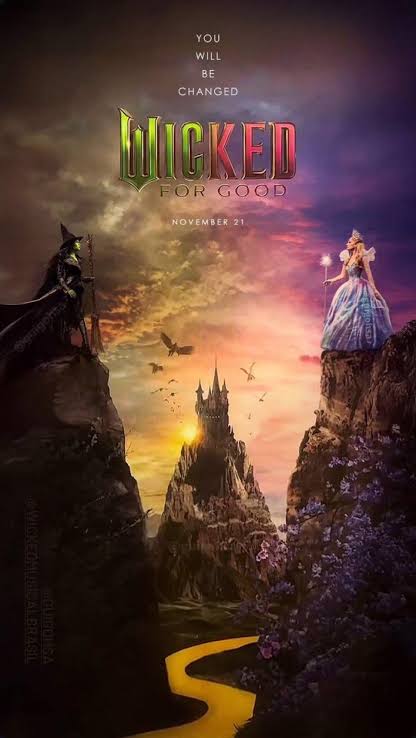
In 2024, Universal Pictures and Marc Platt produced the successful and highly acclaimed musical fantasy Wicked, a film adaptation of the Winnie Holzman–Stephen Schwartz 2003 stage musical, itself loosely based on Gregory Maguire’s 1995 novel. Maguire’s book reimagines L. Frank Baum’s 1900 novel The Wizard of Oz and its 1939 film adaptation.
First announced in 2012, it took a decade for the film to finally roll. Holzman and Dana Fox wrote the screenplay, with Jon M Chu directing. Maguire’s novel runs over 400 pages, and the Holzman-Schwartz stage play runs 2 hours 45 minutes. Not wanting to lose key plot threads, Platt and Universal Pictures divided the film into two parts. Luckily, fans didn’t have to wait long for the epic conclusion, with Wicked: For Good arriving just a year after the first film.
Story
The story picks up from where we leave it, with Elphaba Thropp declared the prime villain of Oz, the Wicked Witch of the West, and the whole land buying into the propaganda. In contrast, posterity casts Glinda the Good as the noble soul who will guide Oz through the darkness. Glinda knows the truth, yet she stands caught between friendship and her duty to the people of Oz, all of whom believe that her goodness will drive all wickedness from their world.
Screenplay & Direction
Maguire’s novel is a sharp allegory on authoritarianism, prejudice, and the politics of power, and far darker in tone. The musical softens these edges, turning its gaze toward friendship, humour, romance, and emotional uplift. Though the period isn’t specified, Maguire’s Oz carries the air of the late 19th to early 20th century. We are a quarter into the 21st, yet nothing seems to change in power politics, or in a world still gullible and easily swayed by propaganda. The truthful is branded wicked; the lie is taken as Gospel.
Holzman and Fox stay largely true to the 2003 musical and its ethos. With Jon M Chu at the helm, casting an Asian-descent actor like Michele Yeoh as Madame Morrible is among the few creative liberties. With a slightly shorter runtime (137 minutes) than the preceding film, Wicked: Far Good moves at a breezy pace. Perhaps Chu and the writers could offer Elphaba a little more room to grieve her personal loss. As with the first film, the Elphaba–Fiyero romance feels somewhat hushed.
Yet Wicked: Far Good still holds you with its storytelling, its music (certainly a slight upgrade from the first film), its compelling performances, and its visual grandeur , above all, its message of sacrifice for the larger good.
Performances

Given its theme of prejudice, casting Cynthia Erivo, a British actor of Nigerian descent, is an apt choice by Jon M Chu and his writers. Cynthia Erivo imbibes the spirit and frustration of Elphaba with fine precision. There can be nothing but empathy for a woman who knows her truth, the ugly truth about the Wizard of Oz, yet finds no one willing to listen. In L Frank Baum’s The Wonderful Wizard of Oz, she is nameless and cast as the chief antagonist. Maguire reimagined Baum’s world with a different vision, humanising the Wicked Witch of the West. He begins by giving her a name, Elphaba, drawn from the initials L-F-B, a quiet tribute to L Frank Baum. Maguire does not dwell on her ethnicity, but her green skin marks her as the odd one out, its colour a reaction to the potion her mother consumed. Erivo carries all of this history and hurt into her performance, delivering an Elphaba of rare power and aching vulnerability.

Though hailed as Glinda the Good, both Elphaba and Glinda are mere pawns in a larger political game. They are both creations and victims of perception. All of Oz hates Elphaba, but Glinda must live through this façade every day of her life. Since childhood, she imagines herself as a radiant fairy who wields a wand and embodies righteousness and goodness. She does become Glinda the Good, but without the magic. ‘Know your role and shut your mouth’ – that message is hammered into her. Often torn between friendship and duty, heartbreak partly nudges her towards duty. We even get a humorous Glinda-versus-Elphaba fight. Glinda has good reasons to feel aggrieved, but in the end, the good in Glinda rises to the fore.
Across the two films, it is Ariana Grande who charms as the vanity queen, a blonde with a good heart. Usually, it’s a wink, but that leaning back and shake of the hair has this writer, and countless viewers, swooning over her. She aces the look, but more importantly, the soul of her character. She chips in with a virtuoso performance full of elegance, grace, innocence, humour, and quiet substance. Her singing is the icing on the cake. A word of praise for little Scarlett Spears who played little Glinda.

It’s not often that a villain holds your attention the way Jeff Goldblum does as the Wizard of Oz. Manipulative yet gentle, the Wizard uses fear and propaganda to stay in power and remain relevant. “Even if you tell them the truth, no one will believe it,” he tells Elphaba. Having perfected the art of selling propaganda and fake miracles, the Wizard has acquired a near-godlike status in Oz. Sell lies long enough and they harden into history. Such is the conviction in Goldblum’s Wizard that it becomes difficult to disagree with him. A master of psychology, he disorients even his adversaries, who begin to doubt their own righteousness – is the good they fight for worth anything at all? Then or now, there’s little change in the world, and the righteous few still struggle to find tough to tell their truth.
The one character you deeply empathise with is Nessarose Thropp, finely played by Marissa Bode. Her disability and heartbreak give Holzman and Fox room to shade Nessa in greys. Jonathan Bailey may feel a little short-changed, as Fiyero has more of an academic presence in the second film, yet he is not denied his destiny in the larger scheme of things. Ethan Slater’s Boq is instantly relatable as the simple Munchkin who perhaps mistakes his infatuation with the gorgeous Glinda for true love.
Music / Technical Aspects
Save for the Popular and Dancing Through Life tracks, we felt Wicked (2024) did not quite enchant musically. Wicked: For Good is an upgrade. All eleven songs fit their moments with ease, and the strong vocals elevate the lyrical pulse. From Everyday More Wicked to Wonderful, No-Good Deed, and The Girl in the Bubble, each number lands exactly where it should.
The visual ambition of Wicked: For Good marks one of its most impressive leaps. Production designer Nathan Crowley constructs an Oz that feels tactile and fully inhabited, a world where towering architecture, crowded alleys, and shimmering halls coexist with an undercurrent of dread. The visual effects team led by Pablo Helman deserves full marks for its meticulous creature work. The animals of Oz, many of them burdened with a permanently frightened gaze, sharpen the film’s commentary on fear and control. The standout, undeniably, is the petrified young Lion, the same cub Elphaba once saved, whose wide-eyed terror becomes one of the film’s most quietly devastating images.
Cinematographer Alice Brooks complements this world-building with a confident, expressive visual language. Her lensing balances spectacle with emotional proximity, bathing Oz in rich contrasts of light and shadow that echo the film’s themes of truth, power and misjudgment.
Final word
With the second part arriving within a year, triggering nostalgia is hardly a concern for Jon M Chu. Having stayed largely true to the 2003 musical, the two Wicked films shine for their storytelling, compelling performances, technical finesse, and visual splendour. Like the leading characters, the viewer, too, grows more accepting of moral ambiguity, in the reel world and the real wicked one, bringing out the true essence of Gregory Maguire’s 1995 novel.
Publisher: Source link