A new dawn in Bollywood’s Indo-Pak warfare – Beyond Bollywood
Questions will be raised over its audacious plot, one that fans ‘unknown gunmen’ theories, but Aditya Dhar’s film packs enough punch to appeal to the target audience. Ranveer Singh does a decent job with his derring-do, but Akshaye Khanna, Arjun Rampal, and veteran Rakesh Bedi steal the show.
Rating: ⭐️⭐️💫 ( 2.5/ 5)
By Mayur Lookhar
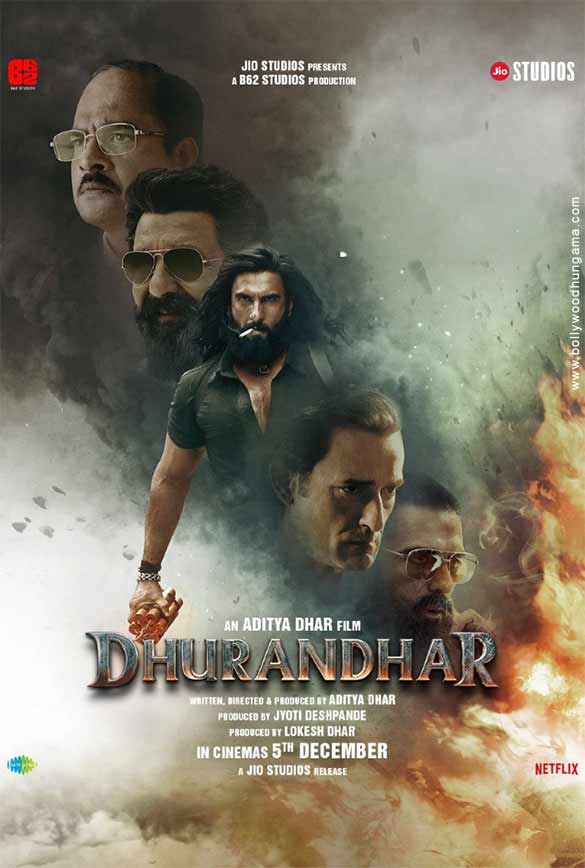
Dhurandhar by Aditya Dhar! A clever title, but don’t mistake it for an Aditya Dhar biopic. Puns aside, the makers even reaffirmed in Delhi High Court that their film is not a biopic of Ashoka Chakra awardee Major Mohit Sharma, but a work of fiction. This came after the film’s teaser and trailer proudly claimed it was based on ‘incredibly true events.’ While ambiguity is likely to continue over the true identity of its lead protagonist (Ranveer Singh), Dhar dared to name and narrate stories of the antagonists – Rehman Dakait and Major Iqbal. The former was a notorious gangster from Lyari, Karachi while the latter is said to be the mysterious man who served as an ISI handler during the 26/11 terror attacks in Mumbai, India. More on these unscrupulous characters later, but first, what is Aditya Dhar’s Dhurandhar all about?
Story
Deeply hurt by the Kandahar hijacking and later the attack on the Indian Parliament, IB Director Ajay Sanyal (R. Madhavan) seeks to give the arch-enemy a fitting reply. With no scope for a direct confrontation, the only available option is a covert operation. As revealed in the end, the idea is to weaken the enemy by taking down elements that arm Pakistani non-state actors. The man assigned to the mission is Hamza Ali Mazari (Ranveer Singh), an ethnic Baloch who wins the confidence of Lyari’s dreaded gangster Rehman Dakait (Akshaye Khanna) and soon uncovers the danger the group poses both locally and across the border. Who really is Mazari? Well, you need to watch the film for that.
Screenplay & Direction
Posthumous personality rights are a reality, but given its conflict and plotlines, Dhurandhar does not appear to bear any resemblance to the late Major Mohit Sharma or any known actions by him. The English disclaimer flashes for barely three seconds, but the Hindi version is read aloud, firmly affirming that the film is a work of fiction. However, when Ranveer Singh’s Hamza steps into Pakistan via Afghanistan in his first scene, the line ‘incredibly true events’ appears on screen.
Real spy operations are classified; therefore, any creative work loosely inspired by them raises questions of breach of secrecy and potential national security implications. Aditya Dhar may explain where he sourced these ‘incredibly true stories’ from, but seasoned journalists Aditya Raj Kaul and Dibya S served as research consultants on the film. Then there’s former armyman-turned-politician Col. Bhupinder Singh Shahi, thanked presumably as a military consultant.
For us, the more intriguing aspect was, what does India, or our intel agencies, have to do with the internal conflict involving Pakistani gangster Rehman Dakait, polarising cop such as Chaudhry Aslam and the power politics of Lyari?

Aditya Dhar’s film ignites the ‘unknown gunmen’ theory, which has prompted the ISI and Pakistan Army to ramp up security for India’s most wanted terrorists. Dhurandhar, set between 1999 and 2009, captures an era when terror networks thrived unchecked. Pakistan’s reliance on terror proxies persists, and beyond Kashmir’s endless border clashes, India’s covert ops from that decade remain shrouded in secrecy. Yet, the film closes with the defiant line “Yeh naya Bharat hai, yeh ghar mein ghuske maarega”. If Mazari is a covert Indian agent, his true mission eludes viewers for much of the runtime. Clarity dawns only amid the chaos of the 26/11 Mumbai attacks, hinting at the bold path ahead. Before that he navigates his way through the power politics, criminal world of Lyari.
Phew, such audacity, but is all this part of the ‘incredibly true stories’ the film proclaims? This is a country where its foreign minister cites social media as an authentic source without hesitation. Rest assured, Pakistan will see Dhurandhar as vindicating their claim of Indian, albeit fictional, meddling in their domestic mess. Trust the naïve Pakistanis to swallow this as hard evidence.

It would be easy to dismiss Dhurandhar as just another Indian spy fantasy thriller, but perhaps it heralds a new dawn in Bollywood’s Indo-Pak warfare, departing from traditional narratives. Pakistan excels at peddling lies in information warfare. Naturally ridiculed in Pakistan, the film paints a different picture of Rehman Dakait, once the darling of the largely Baloch-inhabited town of Lyari, and casts aspersions on the controversial yet beloved SP Chaudhry Aslam Shah (Sanjay Dutt). With its own film industry barely surviving, Pakistanis are riled by a Bollywood depiction of Lyari’s criminal underworld of the 2000s. The Rehman Dakaits, Babu Dakaits, and Arshad Pappus were local gangsters, and Dhurandhar reveals that Pakistan’s crime world extends beyond UN-designated terrorists. Bollywood’s message is clear: “I’ve exposed you, do what you can.” Phew, doesn’t this reshape India-Pak information warfare dynamics?
Dhurandhar will spark discussions in Indian defence circles too, with many likely baulking at its audacious plot. For Aditya Dhar, however, civilian opinion will shape the future of this two-part film, reportedly made on a massive Rs 380 crore budget. The current socio-political environment is conducive to such bravado, and chest thumping nationalism. The film is bolstered by its largely gripping writing, intense characters, outstanding performances, and rich production values.
Acting

Dhurandhar is make-or-break for Ranveer Singh, who is also battered by off-screen controversies. Playing a spy agent assuming a Baloch identity, Singh’s Hamza Ali Mazari needed work on his Baloch accent, hey, but this is a Hindi film. Maintaining a veil of secrecy, Hamza is naturally a man of few words, yet he doesn’t hold back on Baloch pride, impressing even Rehman Dakait. Ordinary civilians have no real whiff of spy agents, but decades of cinema have shaped perceptions. A bulky, Hamza-like figure might raise suspicions elsewhere, but not in Lyari, where muscle rules. Save for action scenes, Hamza stays in the shadows, sustained by the long veil of mystery. Then comes the shocking moment: ISI handler Major Iqbal (Arjun Rampal) and designated criminals like David Headley and Sajid Mir rejoice over the live telecast of the Mumbai terror attacks, with Hamza present, his worried look unnoticed. The bigger shocker? This spy unknowingly handed over weapons to Ajmal Kasab. A flash disclaimer, “this is fiction” might have helped. Overall, Ranveer Singh delivers a fairly competent performance in this avatar.

As always, Akshaye Khanna steals the show with a highly intimidating and gripping performance. Prior to Dhurandhar, few Indians knew he existed, but 16 years after his death, this Indian film sheds light on the dangerous Lyari gangster. Born Abdul Rehman Baloch, he carried a criminal legacy that defined the name ‘Dakait’. The film truly connects the moment Khanna enters the frame: a door opens, revealing a man in a black Pathani suit, eyes soaked with emotion, hustling to see his son’s body. From that moment, it’s an Akshaye Khanna show all the way. Mind you, the film doesn’t glorify Rehman Dakait, it highlights his reign of terror. Aditya Dhar introduces this character as an apex predator, but in that hard-to-watch scene, Dhar shows Rehman taken by surprise by the Pakistan-orchestrated 26/11 terror attacks. That momentary vulnerability lulls you into believing Dakait could display a different shade. He does, but for the worse, abandoning all Baloch pride for power and Lyari’s dirty money. At 50, Khanna plays a character who only lived to 29-30, but age only amplifies the scare around this Dakait.

Arjun Rampal’s character, Major Iqbal, remains shrouded in mystery. Convicted American-Pakistani terrorist David Headley named him as the ISI handler who provided funds and logistics for the 26/11 attacks. With his face still unknown, Aditya Dhar shapes Major Iqbal around another dreaded terrorist, Ilyas Kashmiri, who beheaded and mutilated Indian soldier Bhausaheb Maruti Talekar in 2000. Dhar has Iqbal commit the most brutal torture on an Indian spy, choosing this moment to deliver former Pakistani dictator Zia-ul-Haq’s infamous “bleed India by a thousand cuts” line. Surprisingly, Dhar claims Iqbal heard it on the radio in 1971, but Zia only rose to Army Chief in 1977, becoming President via military coup a year later. If Rehman Dakait was butcher-like, then Iqbal is no less, with Arjun Rampal justifying his director’s faith in him.

Sanjay Dutt is a fine fit to play Chaudhry Aslam Khan. It must be recalled that Khan assumed the title of Chaudhry later, but he belonged to the Arghul lineage in Khyber Pakhtunkhwa, where Pashto and Hindko are the two main languages. Dutt is shown as a proud Punjabi with total distrust for Baloch people. The credits list him in a special appearance, perhaps indicating the second part may feature little of Chaudhry Aslam Khan.

The true-blue scheming Pakistani Punjabi is played by veteran Rakesh Bedi, remember his Punjabi bureaucrat in Uri: The Surgical Strike (2019). Bedi’s Jameel Jamali in Dhurandhar is a master politician who knows how to survive in Lyari’s gangster paradise. In a film packed with brutal action, Jamali brings humour through his political acumen and blabbering. He epitomises the Pakistani Punjabi who sweet-talks one moment and stabs you in the back the next.

Amidst all the terror, violence, and power plays, where does Sara Arjun fit? Having impressed as a child artist, she graduates to her maiden female lead role as Yalina Jamali, the 19-year-old who submits her heart to Hamza. Aditya Dhar smartly uses the 20-year age gap between Ranveer and Sara, justifying the Yalina-Hamza relationship as a tacit plan to spy on Jameel Jamali.
Finally, it leaves us with Ajay Sanyal (R. Madhavan), described as the charioteer of Karma. While Madhavan is competent, you are intrigued by the Ajit Doval look. Dhurandhar opens with the sight of Sanyal gazing at the IC-814 aircraft in Kandahar. The dullest moments of the film come early, largely featuring Sanyal. Ajit Doval was Additional Director at that time; he graduated to the position of Director in 2004 and served for a year before retiring. Here we have Sanyal continuing till the climactic events of 2009. We found it bizarre how, in the years 1999-2002, this Sanyal is the face of the Intelligence Bureau, undermining the then IB chiefs.

Usually, Aditya Dhar films don’t forget to credit nationalistic leaders in power. Here, however, Dhar doesn’t disturb the Prime Minister or Home Minister. The Manmohan Singh government, which came to power in 2004 and served till 2013, also gets no mention. Don’t think the late great Manmohan Singh would have complained.
We spoke of secrecy in matters of national security, but the one big blunder Dhar commits is having Ajay Sanyal describe the origins of Dhurandhar and explain the operation. Come on, even for an entirely fictional film, you don’t alert your enemies to your modus operandi. The country has already suffered diplomatically with the Nijjar killing in Canada. And here Aditya Dhar’s film openly takes pride in saluting the unknown gunmen. How this critical point escaped the eyes of the CBFC is baffling.
Music / Technical aspects
Shashwat Sachdev’s playback music isn’t particularly appealing, but he makes amends with a gripping background score. Diljit Dosanjh faced backlash for casting Pakistani actress Hania Aamir in Sardaar Ji 3, but redeems with patriotic flair in Ez Ez track. Dhurandhar. also shines for its cinematography and production values. Well, Lyari residents are best positioned to comment on the Lyari depicted in this Bollywood film. Though some scenes are brutal, Aditya Dhar relies more on drama, with the final action sequences well crafted.
Final Word
At three hours and 34 minutes, including a 4-minute teaser of the second part, the runtime will evoke different views. Many will likely call it exhausting, but those who understand the genre and history will have the patience to unravel the film chapter by chapter, as evident in this screenplay. The big question facing the second film is what lies ahead, does it have some incredibly true story left, or will Dhurandhar 2 be a work of pure fiction? Mark March 19th in your 2026 calendar.
Watch the video review below
Publisher: Source link